
Bank Loan Versus Pawnbroking: Which Is Faster?
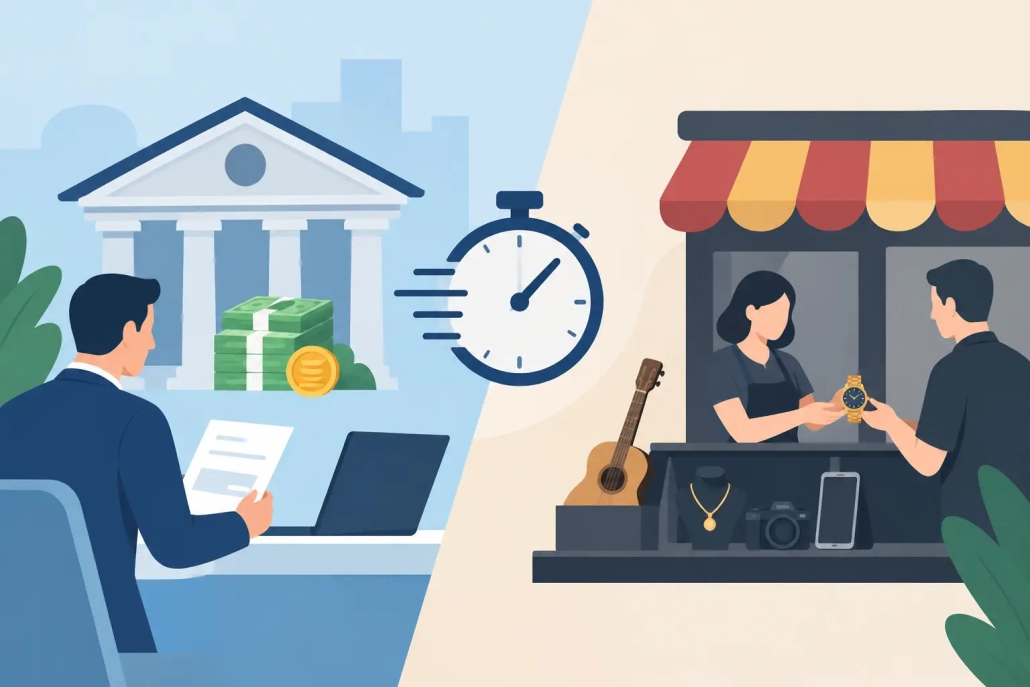
A broken work ute, overdue supplier invoice or surprise repair bill does not wait for a bank appointment. When cash is needed quickly, the question of bank loan versus pawnbroking comes down to one thing: can you access the money you need in time, without making an already stressful situation harder?
A bank loan may suit planned spending and borrowers with time, steady income and a strong credit history. Pawnbroking can suit an urgent, short-term cash gap when you own a valuable asset outright and want a straightforward path to funds. Neither option is automatically right for every person. The useful choice is the one that matches your deadline, your ability to repay and the asset you are prepared to use as security.
Bank loan versus pawnbroking: the key difference
A bank generally lends based on you as the borrower. It looks at your income, regular expenses, existing debts, credit history and ability to make repayments. Even when a bank loan is unsecured, the bank needs confidence that your finances support the loan.
Pawnbroking works differently. The loan is secured against an item of value, such as a car, motorbike, boat, caravan, ute, van or machinery. The lender assesses the asset and offers an amount based on its value, rather than making the decision primarily on your credit score or employment paperwork.
That difference matters if your vehicle or equipment has equity but your financial paperwork is not picture-perfect. A recent job change, a credit issue, variable self-employed income or a one-off cash-flow problem can slow down a mainstream application. Asset-backed lending gives owners another option to consider.
When a bank loan makes sense
A bank loan can be a sensible choice when you are not under immediate pressure and can comfortably manage regular repayments over a longer period. It may be suitable for a planned purchase, consolidating debts where the numbers genuinely stack up, or a larger expense that needs a structured repayment schedule.
Banks can offer competitive rates for borrowers who meet their criteria. However, approval is not only about the advertised rate. You may need to provide payslips, bank statements, identification, details of your expenses and information about existing loans. The lender may conduct a credit check and assess whether the repayments are affordable.
For some people, that process is manageable. For others, it is the reason a bank loan is not practical. If your mechanic needs payment today, waiting days for an application decision may not solve the immediate problem. An application can also be declined, even where you own a valuable vehicle outright.
A bank loan is usually the better fit if you have time to compare offers, predictable income and a repayment plan that works over months or years. It is less useful when speed is your first priority.
When pawnbroking can be the practical option
Pawnbroking is built for short-term access to cash against an asset you already own. Rather than applying for an unsecured personal loan and hoping your financial profile meets the lender’s criteria, you put forward the asset as security.
For vehicle-backed pawnbroking, the vehicle or equipment needs to be unencumbered, registered and roadworthy. Its condition, make, model, age and market demand all affect the loan amount. A lender may advance a percentage of the asset’s wholesale value, so the amount available will not necessarily match what you paid for it or its retail asking price.
The main advantage is speed and simplicity. Where the asset is suitable and ownership can be confirmed, the assessment focuses on the vehicle rather than a lengthy review of your income, expenses and credit file. That can make a real difference for a tradie with a short-term gap before a customer payment lands, a small business owner covering wages, or a family dealing with an unexpected bill.
At AutoPawn, eligible customers can seek cash against vehicles and equipment without credit checks, proof of income, application fees or the usual bank-style paperwork. The amount offered is based on the asset, with advances of up to 55% of wholesale value. That is a practical option for owners in Brisbane and the Sunshine Coast who need a clear answer quickly.
Speed is not the only comparison
It is easy to focus on how fast the money arrives. But before choosing a bank loan or pawnbroking loan, look closely at what happens after you receive the funds.
With a bank loan, you will usually make scheduled repayments. Missing repayments can lead to fees, collection activity and damage to your credit file. Because a bank loan can run over a longer term, it is important to understand the total amount you will repay, not just the weekly or monthly figure.
With pawnbroking, you borrow against a specific asset for an agreed period. You need to understand the repayment date, the loan charges, any available extension process and what happens if you cannot redeem the item. If the loan is not repaid under the agreed terms, the secured asset may be sold to recover the loan balance.
That is why pawnbroking is best treated as a short-term solution, not a way to carry ongoing financial pressure month after month. If you have a clear source of funds coming soon, such as an invoice payment, sale proceeds or a known work payment, an asset-backed loan may be a practical bridge. If there is no realistic repayment path, pause before borrowing and consider getting financial support or budgeting advice first.
Compare the real cost, not just the headline
A lower advertised interest rate does not always mean a cheaper or more suitable loan for your circumstances. A bank loan can include establishment fees, monthly fees, late fees and interest over a longer term. Pawnbroking has its own charges and conditions, which should be clearly set out before you accept the loan.
Ask for the total amount required to redeem your asset by the due date. Read the contract carefully and make sure you understand each fee, the exact due date and the consequences of late payment. A reputable lender should explain the process in plain language and give you the information you need to decide.
It also pays to be realistic about the value of the item. Do not borrow the maximum simply because it is available. Borrow what solves the immediate problem, then keep the repayment amount within reach. A smaller loan against a vehicle you value can reduce pressure when redemption day arrives.
Questions to ask before using your vehicle as security
Before arranging a pawnbroking loan, make sure the vehicle is genuinely yours to use as security. If it still has finance owing, is under a lease, or is subject to another claim, it may not qualify. Gather your identification and ownership details so the assessment can move quickly.
Then ask yourself whether you can manage without the asset for the loan period. For many people, a work vehicle is essential to earning an income, so the practical impact matters just as much as the loan amount. Be upfront about how the vehicle is used and ask how it will be handled while it is held as security.
Finally, make your repayment plan specific. Do not rely on a vague hope that things will improve. Identify where the redemption money is coming from, when it is due to arrive and what you will do if it is delayed.
Choose the option that fits the deadline
A bank loan can work well when you have time, meet lending criteria and want a longer repayment structure. Pawnbroking can work well when you need fast cash, own an eligible asset outright and have a clear plan to repay and redeem it.
The best decision is not about pride or a perfect credit score. It is about choosing a straightforward solution that deals with the immediate pressure without creating a bigger problem later. If you have a valuable vehicle or piece of equipment and a short-term cash gap, get the facts, know the repayment date and make the decision with your eyes open.



Leave a Reply
Want to join the discussion?Feel free to contribute!