
Pawn Loan vs Cash Advance for Urgent Bills
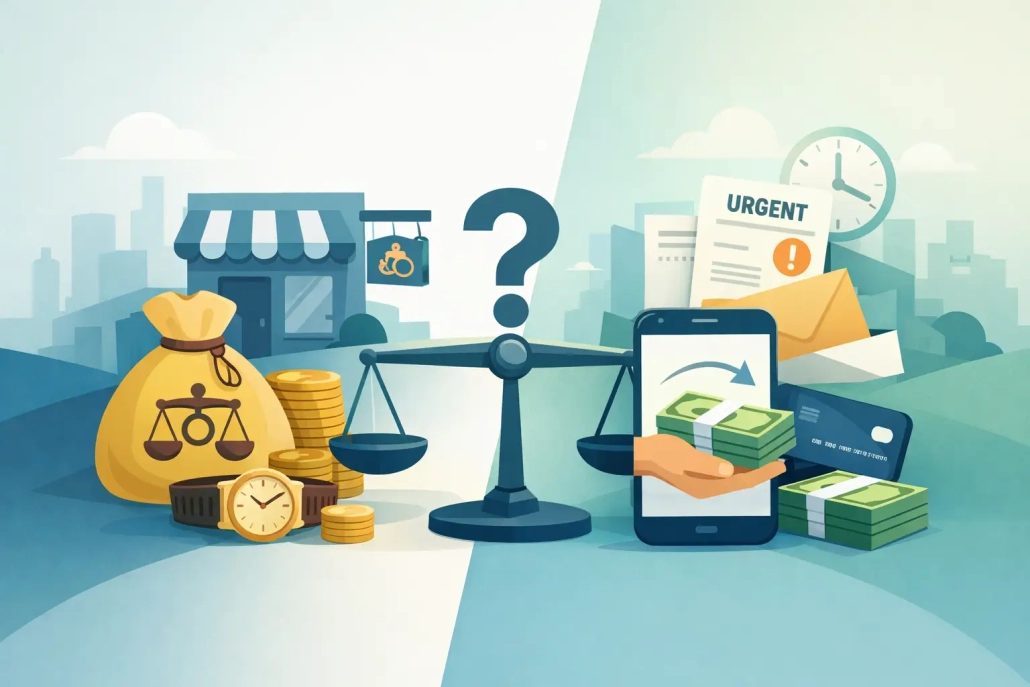
A pawn loan vs cash advance decision usually comes down to one question: do you have a valuable asset you can use as security, or are you borrowing against money you expect to receive soon? When the rego, mechanic’s bill or supplier invoice cannot wait, knowing the difference can save time and help you choose a loan that fits the pressure you are under.
Both options can provide short-term funds, but they work in very different ways. A pawn loan is secured by an asset. A cash advance is generally unsecured and based on your income, employment, bank activity or expected pay. That difference affects approval, paperwork, costs and what happens if you cannot repay on time.
Pawn Loan vs Cash Advance: The Key Difference
With a pawn loan, the lender assesses the item offered as security rather than relying only on your credit history or income. The amount available is based on the asset’s resale or wholesale value, condition and demand. If you own an unencumbered, registered and roadworthy car, motorbike, boat, caravan, truck, ute or piece of machinery, it may be possible to turn that value into cash quickly.
A cash advance is usually a small, short-term loan. Depending on the provider, you may be asked for payslips, bank statements, regular income details and identity documents. The lender may assess your repayment capacity and may run credit checks. Approval can still be quick, but it is tied more closely to your financial position than to an asset you own.
Neither option is automatically better. The right choice depends on how much you need, what security you can offer, how soon you can repay, and whether you are comfortable using an asset as collateral.
How a Pawn Loan Works
A pawn loan is a secured loan. You bring forward an asset you already own to access part of its value now. The lender values the asset, makes a loan offer, explains the loan terms, and provides cash if you accept.
For vehicle-backed lending, the vehicle’s condition and paperwork matter. You will generally need to show that it is yours to offer as security and that there is no finance owing on it. A clear title, current registration and roadworthy condition can all affect whether the asset is suitable and how much can be advanced.
The asset matters more than your credit score
This is the main advantage for people who have hit a rough patch, are self-employed, work contract jobs, or simply do not want a bank-style application. A secured pawn loan may be assessed on the vehicle or equipment instead of your credit score and income history.
That does not mean you should ignore the repayment terms. You still need to know the loan amount, the fees and charges, the due date, extension options and what happens if the loan is not redeemed. Fast cash is useful only when the agreement is clear.
Understand possession and default before signing
Traditional pawnbroking commonly involves the lender holding the item while the loan is outstanding. With large assets such as vehicles and equipment, arrangements can vary. Ask exactly where your asset will be kept, whether it is insured while in storage, what documents or keys are required, and how you collect it after repayment.
If you do not repay or make an agreed extension, the lender may have the right to sell the secured asset to recover the debt. That is the trade-off for a loan that can be simpler to access. Do not offer a vehicle, boat or machine you cannot afford to lose if your repayment plan is uncertain.
How a Cash Advance Works
A cash advance is often marketed as a quick answer to a short gap before payday. Some are wage advances offered through an employer or app. Others are small amount credit contracts or payday-style loans from a lender. The name may sound simple, but the terms can vary widely.
Unlike a pawn loan, there is normally no vehicle or other valuable item securing the loan. Instead, the provider looks at your ability to repay from upcoming wages or other income. This can suit someone who has regular pay and only needs a modest amount for a short period.
The downside is that repayments can bite hard when your next pay lands. If rent, groceries, fuel and direct debits are already due, taking a large chunk from your next pay can create another cash gap straight away. Repeatedly rolling from one advance to the next is a warning sign that the product is not solving the underlying problem.
In Australia, lenders offering consumer credit have obligations around responsible lending, but you should still read the contract closely. Check the total amount you will repay, not just the amount deposited into your account. Establishment fees, monthly fees, default fees and direct debit charges can make a small advance more expensive than it first appears.
Compare the Costs, Risk and Speed
The quickest way to compare a pawn loan and a cash advance is to look beyond the headline promise of same-day money. Ask what the loan is secured against, how it is assessed, and what the real consequence is if repayment goes off track.
| Question | Pawn loan | Cash advance | |—|—|—| | What supports the loan? | A valuable asset, such as a vehicle or equipment | Usually your income and ability to repay | | Is a credit check always needed? | Not always, depending on the lender and asset | Often part of the lender’s assessment | | How is the loan amount set? | Based largely on the asset’s assessed value | Based on income, expenses and provider limits | | What is the main risk if you cannot repay? | You may lose the secured asset | Fees, collection action and further pressure on your budget | | Who may it suit? | Asset owners needing a larger or faster secured loan | People with reliable income needing a small, short-term amount |
A pawn loan can be a practical option when you own an asset with clear value but your credit file, income paperwork or timing makes an unsecured application difficult. It can also make sense when you need more than a small cash advance would provide.
A cash advance may suit a smaller, genuinely short-term expense when you know exactly how it will be repaid from your next pay. It is less suitable if you are already behind on several bills or do not have dependable incoming income.
Questions to Ask Before You Take Fast Cash
Do not let urgency stop you from asking direct questions. Before accepting either product, confirm the total repayment amount and the exact due date. Ask whether early repayment reduces costs, whether an extension is available, and what fees apply if you miss a payment.
For a pawn loan, ask how the asset is valued and what happens if it sells for more than the debt after you default. For a cash advance, ask how repayments will be collected and whether the scheduled amount leaves enough for your essential living costs.
It also helps to be realistic about the purpose of the funds. Paying for an emergency repair that keeps you earning is different from borrowing to cover regular expenses every fortnight. If the same shortfall keeps returning, consider speaking with a free financial counsellor before adding another repayment.
When a Vehicle-Backed Pawn Loan May Make Sense
For tradies, small business owners and everyday vehicle owners, a vehicle can be more than transport. It can be the asset that helps bridge a cash-flow gap while you wait on an invoice, replace a failed tool, cover an urgent repair or deal with an unexpected expense.
If you own an eligible asset outright, a vehicle-backed pawn loan can offer a more direct path than an unsecured cash advance application. At AutoPawn, eligible Queensland customers can access loans against vehicles and equipment, with loan amounts based on up to 55% of wholesale asset value. There are no credit checks, proof of income requirements or application fees, so the focus stays on the asset and getting a clear answer quickly.
The sensible move is to choose the loan you can explain in one sentence: what you are borrowing, what it will cost, when you will repay it, and what you risk if you cannot. When those answers are clear, fast cash can be a practical tool rather than another source of stress.



Leave a Reply
Want to join the discussion?Feel free to contribute!